µCurrent
A Professional Precision Current Adapter for Multimeters
|
electronics.alternatezone.com |
|
|
µCurrent |
µCurrent
A
Professional Precision Current Adapter for Multimeters
Here is something you probably didn't know:
NO
digital multimeter is accurate at measuring DC or AC current
in low voltage circuits.
The closer to full scale you get and the
lower your circuit supply voltage gets, the more inaccurate your
current measurement gets.
YES, that includes
your expensive "precision" 0.05% Fluke!
How is this possible? - It's called Burden Voltage.
Many people are aware of Burden Voltage, but few people are aware of how bad this effect can be in practical circuit current measurements with a multimeter.
Don't believe it?, take this simple test with your multimeter:
Try to measure 190mA on the 200mA current range (pretty simple huh?)
Read your manual to find out your meters "burden voltage" (I bet you don't know it off the top of your head) (e.g. a Fluke 87V is 1.8mV/mA)
Do the simple math to see what voltage your meter is dropping (e.g. 190(mA) * 1.8mV = 0.342V
Now calculate what effect this drop has on your circuit at 5V, 3.3V, or something like today's modern devices that need 1.2V supplies.
Is
your 1.2V circuit going to work at 0.86V?, or your 3.3V circuit at
2.96V?, or even your 5V circuit at 4.66V?
That's what a Fluke 87V
meter will do to your measurement!, and that's a GOOD meter.
Even
if your circuit "works", what will that change in voltage
do to your current consumption?
Try the same again with a Fluke 77-III or 79-III, you will be SHOCKED at the result!
"Ah,
but I can just switch to the 2A or 10A range and the problem is
GONE!"
Sorry! - you've just LOST one or two digits of
resolution!, AND your meters 10A range is much less accurate than
the 200mA range.
Does that come as a surprise? That's ok, you aren't alone, most people are not fully aware of this severe limitation of their multimeter.
The uCurrent is the only commercially available solution to this problem:
As published in the April 2009 issue of Silicon Chip Magazine.


|
Specifications
|
|
PLEASE NOTE: Due to need to keep the burden voltage low, overload protection is NOT INCLUDED in the design. That means NO FUSES. Care is required in using the unit to prevent overloads.
Read the FULL ARTICLE
View the SCHEMATIC
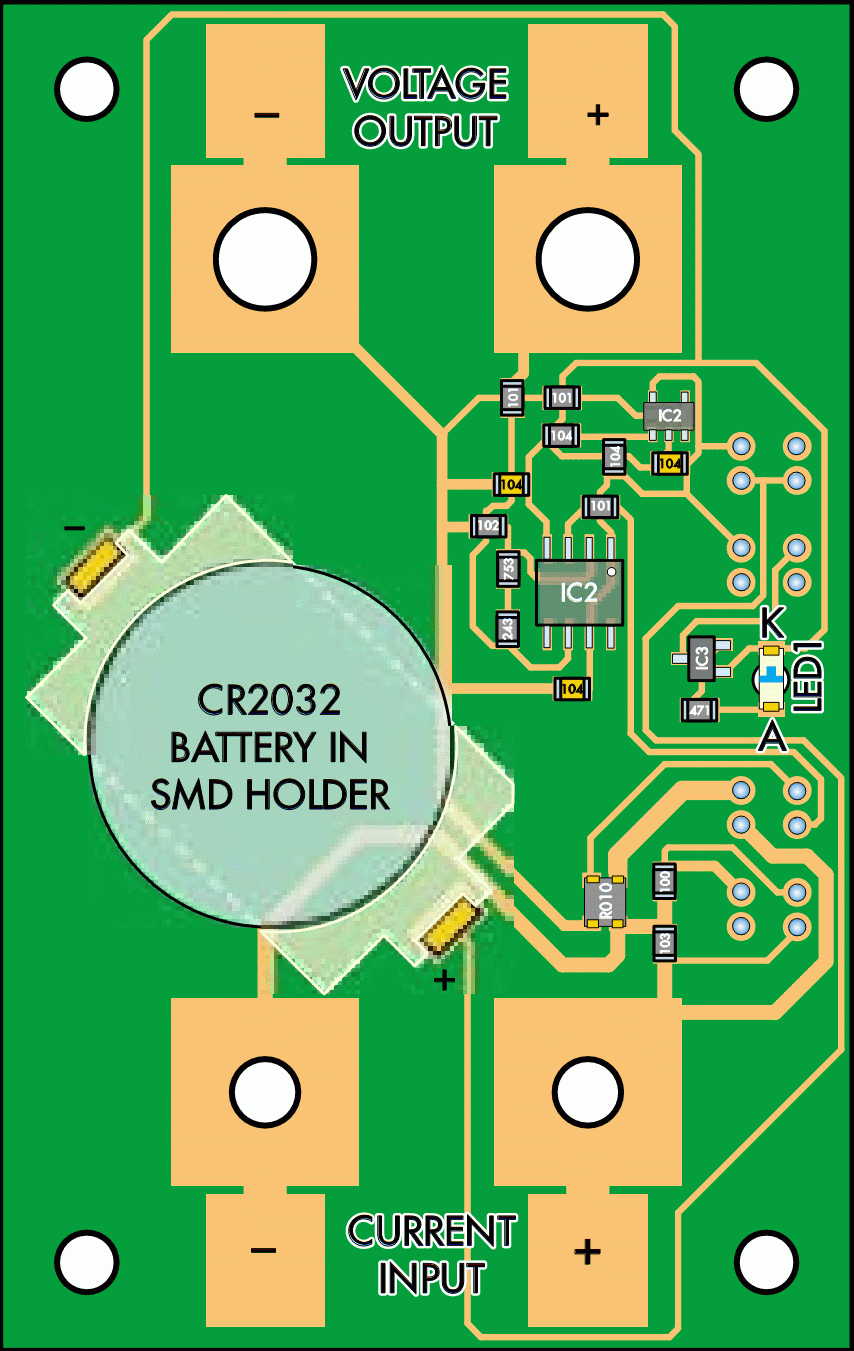
View the bottom side PCB assembly
View the bottom side Component Overlay (the one in the SC article is hard to read!)
Here I am talking about the µCurrent in my EEVblog
Buy a fully built and tested uCurrent:
Fully built and tested units only are available, the kits have sold out and will not be offered again. The uCurrent does not come with any instructions, instructions and notes are in the Silicon Chip article if you require them.
Prices include postage by regular airmail.
The fully
built units are supplied with battery ready to go, but no test
leads are supplied.
All parts are prime spec, sourced from
the original manufacturers. The box is manufactured in Australia, and
the PCB is also assembled in Australia.

NOTE: This is my OLD website. The latest website is here:
http://www.eevblog.com/ucurrent
You
can buy the uCurrent at Adafruit
Or
my EEVblog Shop
for Australian customers ONLY.
Questions?/Comments? EMAIL: david AT alternatezone DOT com
since 17th Feb 2009